
Sabrina González Pasterski is a remarkable figure in theoretical physics, often celebrated as the ‘next Albert Einstein.’ From a very young age, she reached impressive milestones in her career. Even before she was old enough to get her driver’s license, Pasterski had already designed and built a single-engine aircraft, a true testament to her early intellect and mechanical talent.
Her academic path is just as inspiring. At just 32, she has accomplished so much: graduating at the very top of her class at MIT, one of the nation’s most prestigious schools, and earning a PhD from Harvard University, solidifying her standing in top-tier academic circles. She also showed her passion for fundamental research by turning down a lucrative $1.1 million offer from Brown University to focus fully on her love for physics.
Currently, Dr. Pasterski is leading pioneering research at the Perimeter Institute for Theoretical Physics in Waterloo, Canada. Her main focus is on some of the most profound questions in physics, particularly the challenge of unifying gravity with quantum mechanics. Her work involves creating detailed models of the universe as a hologram, with the goal of connecting the large-scale structure of spacetime, as explained by Einstein’s general relativity, with the fascinating probabilistic nature of quantum physics theory. This research could be a major step toward creating a unified theory of quantum gravity.
A childhood shaped by flight
Sabrina González Pasterski grew up in Chicago as a first‑generation Cuban American, and her parents, Mark Pasterski and Maria Gonzalez, both work as lawyers.
From a young age, she attended public schools, starting at the Edison Regional Gifted Center, where teachers recognized her early obsession with the sky rather than the ground. Her passion for physics and flight ignited around age 9 during her first airplane journey, transforming a fleeting interest in space and aircraft into a lifelong pursuit.
For her birthday, her grandfather gifted her a Cessna 150, and her father, a licensed pilot, took her to Canada to log real flying lessons before she was old enough to do so in the U.S. By age 10, she moved from just watching planes to actively building, beginning with an airplane engine, and at 12, tackling a full-scale project: a Zenith CH 601 XL kit plane.
Over more than 2 years, she built the aircraft herself, implementing several modifications and managing the formal airworthiness certification process. She recorded the entire building process by filming and uploading it, creating a silent digital record of her efforts. Before the National Transportation Safety Board grounded all aircraft based on that Zenith kit, she completed a supervised flight test with a certified instructor. At age 14, she piloted the aircraft alone, taking off in a plane she built herself, a full year before she was legally allowed even a learner’s driving license in Illinois.
A Product of Public Education
Pasterski attended Chicago public schools throughout her childhood and adolescence. She later enrolled at the Illinois Mathematics and Science Academy, a selective residential high school. Her path into elite universities did not follow a conventional private-school pipeline. Instead, she carried documentation of her aviation projects into her MIT application.
Despite her impressive achievements, MIT initially waitlisted her. Faculty eventually recognized her unique blend of practical engineering skills and profound theoretical interest. She enrolled, completed her degree in 2013, and graduated with a flawless 5.0 GPA after 3 years. She also made history as the first woman in decades to graduate as the top student in MIT’s physics department. Not only that, but she also won the Joel Matthew Orloff Award, which recognizes the department’s top graduating student.
Recognition arrived early
At age 19, she was featured in Scientific American’s “30 under 30” list. In 2015, Forbes included her in their “30 under 30” Science list, and later that year, she was recognized on the Forbes All-Star list. These achievements occurred before her most famous research at Harvard. In an interview with Yahoo, Pasterski stated that her motivation was: “Years of pushing the bounds of what I could achieve led me to physics,” she said. She described the discipline not as a career but as a way of living. “It’s not like a 9-to-5 thing. When you’re tired, you sleep, and when you’re not, you do physics.”
The Spin Memory Effect and Hawking’s Attention
Following MIT, Pasterski moved directly to Harvard University at 21, joining Andrew Strominger’s research group. As the Gwill E. York Professor of Physics and head of Harvard’s Center for the Fundamental Laws of Nature, he directed her shift from engineering to core questions in theoretical physics. She began examining the connection between general relativity and quantum field theory.
Strominger recognized her talent early and granted her significant independence. By her second year as a PhD student, she was able to choose any topic and collaborator she wished. This level of trust from a senior faculty member was rare for a student at that stage, signifying that Harvard’s physics department regarded her as an extraordinary talent.
The spin memory effect, discovered by Pasterski and her colleagues at Harvard, differs from the previously studied gravitational memory. While earlier research focused on permanent displacements caused by gravitational waves, the spin memory effect describes a continuous rotational twist in spacetime. This twist is the result of the angular momentum that is carried away by the gravitational waves as they pass.
A framework that connects three ideas
This discovery contributed to what physicists now call the Pasterski-Strominger-Zhiboedov triangle. This unified “triangle” framework has transformed the theoretical understanding of spacetime boundaries. It establishes a single, coherent picture by connecting soft theorems, asymptotic symmetries, and memory effects. Specifically, it links the low-energy behavior of particles to the mathematical structure governing scattering processes and to measurable phenomena, such as spin memory.
In 2016, Stephen Hawking referenced 3 of Pasterski’s papers in his published work, with 2 of the papers being co-authored with her Harvard colleagues. The other was an independent paper she published after gaining academic freedom from Strominger. This citation from one of the most renowned physicists in history validated her research, highlighting its significant impact on ongoing discussions about black holes, information, and quantum physics and gravity.
Pasterski earned her PhD in 2019 and published it in Physics Reports, becoming only the second Harvard PhD candidate to do so. After graduation, she undertook a postdoctoral fellowship at the Princeton Center for Theoretical Science, where she continued studying scattering in asymptotically flat spacetimes and expanded her research on infrared structures in various gravity theories.
Turning Down $1.1 Million and Choosing Perimeter
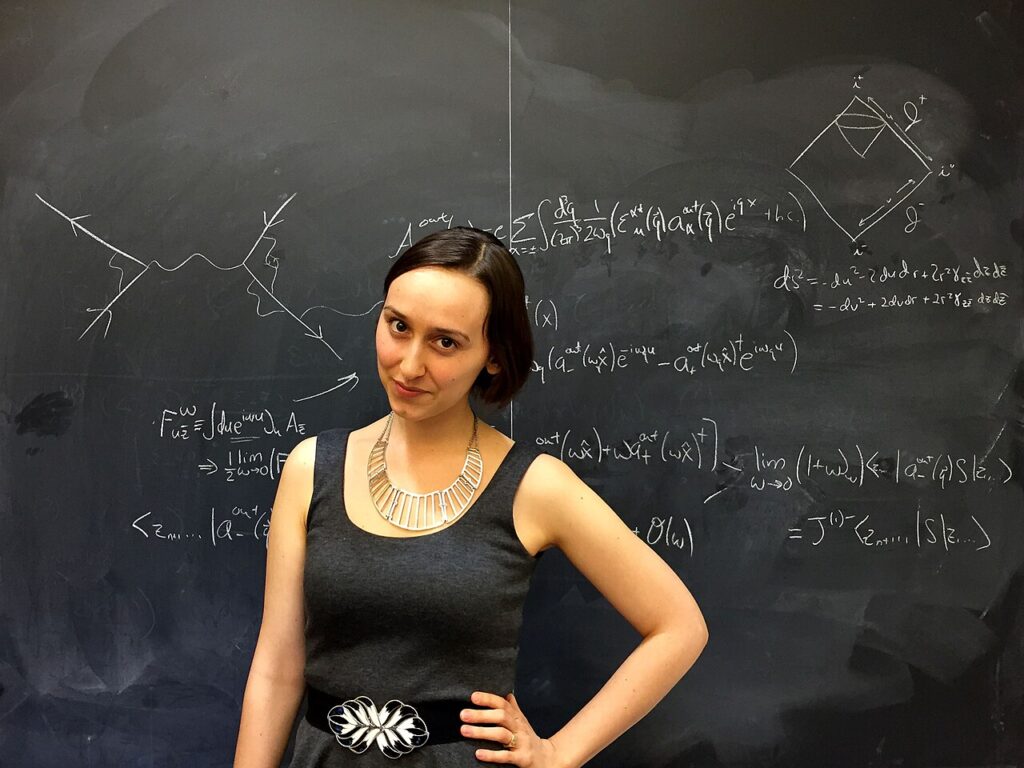
As her publication record and reputation grew, universities began competing for her attention.Brown University offered Pasterski a package reportedly worth $1.1 million to join its faculty as an assistant professor. For most early-career physicists, an offer of that size would be impossible to refuse. Yet she treated it as one option among many, not a once-in-a-lifetime lifeline.
Declining A $1 Million Offer
In 2021, Pasterski turned Brown down to instead join the Perimeter Institute for Theoretical Physics in Waterloo, Canada. Perimeter operates as a privately funded centre dedicated entirely to theoretical physics. It carries no undergraduate teaching obligations and minimal administrative burdens. This structure gives researchers the freedom to focus on long-term, high-risk problems without the pressures of a traditional university appointment.
Perimeter sits next to the University of Waterloo but operates outside a standard departmental hierarchy. That environment matched Pasterski’s track record of prioritizing difficult problems over conventional résumé building. Her move also signalled confidence that her work would attract support without a traditional tenure ladder.
She preferred MIT over easier choices, Harvard over safer alternatives, and now Perimeter over financial stability. Every step prioritized addressing fundamental questions in physics rather than traditional academic achievements. She also became one of the youngest faculty members at Perimeter upon her arrival. This pattern shows a consistent willingness to trade security for a sharper intellectual focus.
Leading the Celestial Holography Initiative
At Perimeter, Pasterski now leads the Celestial Holography Initiative. The program operates with support from an $8 million grant from the Simons Foundation. It brings together researchers in amplitudes, mathematical physics, and quantum gravity. Their goal is to explore whether our four-dimensional universe can be entirely described by a two-dimensional theory defined on the celestial sphere. The Simons supports postdoctoral positions, visitor programs, and extended stays for international collaborators. Weekly seminars and focused workshops help different subfields speak a shared technical language. Celestial holography builds upon the holographic principle, which posits that the information within a volume of space is encoded on its boundary.
In this setup, the Pasterski team connects scattering processes in four-dimensional spacetime to correlators in a two-dimensional conformal field, thereby bridging these concepts. The team examined this mapping to identify hidden symmetries and set bounds on potential quantum gravity theories. Before this, they were studying anti-de Sitter space in holographic dualities, which is not quite like our actual universe. Celestial holography instead uses the lightlike boundary of flat spacetime as the stage for the dual theory.
The Potential Impact Of the Celestial Holography Initiative’s Research
Achieving success in celestial holography might just unlock solutions to one of physics’s biggest mysteries: bringing together general relativity and quantum mechanics. Pasterski’s objective is to “unit[e] our understanding of spacetime with quantum theory,” a feat that would fundamentally alter how physicists describe the universe. If successful, this approach could clarify how information escapes or survives inside black holes. It could also organize messy scattering data into structures that point toward a consistent quantum gravity theory. For Pasterski, that possibility justifies turning down prestige, stability, and even million-dollar offers.
Beyond the “Next Einstein” Label
Media outlets often discuss Pasterski as the “next Albert Einstein,” highlighting some shared traits: both explore profound questions about spacetime, gained widespread attention early on, and changed how physicists think about gravity. But this comparison tends to oversimplify the complexities of today’s theoretical physics.
Different Eras Demand Different Thinking
Einstein developed relativity while still wrestling with what would later become quantum theory, and he never fully accepted its probabilistic character. In letters to Max Born, he praised quantum mechanics as powerful yet insisted that “He does not play dice with the universe,” arguing that the theory could not be a complete description of reality. He spent decades probing its foundations through thought experiments such as the Einstein-Podolsky-Rosen paper, which framed quantum theory as accurate but unfinished.
Pasterski works on the opposite side of that historical divide. She considers quantum field theory and general relativity as foundational principles and utilizes tools like celestial holography to explore whether spacetime and quantum information can seamlessly coexist within a unified, coherent framework. In that sense, her program extends the conversation Einstein started about what a complete theory of nature should look like, but does so from inside the quantum realm he always viewed with measured distrust.
Carrying The Label, Carefully
Pasterski has discussed how being labeled “the next Einstein” can feel overwhelming. She explains that this expectation often comes from headlines and outside opinions, not from her personal sense of being prepared. That awareness shapes how she presents herself publicly. She keeps a relatively low profile, maintains her website to archive research, and appears in interviews focused on substance rather than celebrity.
Read More: Teen Joins Mensa at 13 After Surpassing Einstein’s Estimated IQ – No Prep Required
Advocacy Beyond The Lab
Pasterski has leveraged her visibility to promote wider access to STEM education. She collaborated with Let Girls Learn, an initiative launched during the Obama administration to help girls worldwide access quality education. Her efforts were acknowledged by the White House in 2016. Her personal journey from Chicago public schools to leading physics institutions worldwide shows that nontraditional paths can lead to remarkable success.
Sharing Physics With The Public
Through her YouTube channel, PhysicsGirl, she offers talks and explanations of her research. This method gives students and the public direct access to complex ideas, explained by the researcher herself. It represents a form of outreach, something Einstein never had to consider, that is now vital for how modern physicists build communities around challenging topics.
Where The Real Questions Live
In an interview with Discovery Canada, Pasterski offered a window into how she thinks about the future. “I don’t know exactly what problem I will or will not end up solving,” she said. “The fun thing about physics is that you don’t know exactly what you’re going to do. And normally things just change very quickly, kind of irreversibly, if they’re really right.”
Read More: Research Suggests a Historic Drop in Intelligence Compared With Previous Generations
Trending Products

Red Light Therapy for Body, 660nm 8...

M PAIN MANAGEMENT TECHNOLOGIES Red ...

Red Light Therapy for Body, Infrare...

Red Light Therapy Infrared Light Th...

Handheld Red Light Therapy with Sta...

Red Light Therapy Lamp 10-in-1 with...

Red Light Therapy for Face and Body...

Red Light Therapy Belt for Body, In...

Red Light Therapy for Shoulder Pain...
