
In 1978, the US Navy frigate USS Stein (FF-1065) had to hurriedly return to its home port due to a critical issue. The Stein, a Knox-class frigate initially classified as a destroyer escort before being reclassified in 1975, experienced a major malfunction in its AN/SQS-26 sonar system. This sophisticated low-frequency sonar was vital to the ship’s anti-submarine operations, enabling it to detect, track, and engage enemy submarines from considerable underwater distances. Without it, the frigate lost its key acoustic advantage, rendering it effectively blind below the surface and vulnerable to submarine threats in open water.
The Investigation Begins
Following its arrival at the naval base, the USS Stein was immediately moved into dry dock for necessary repairs. A formal technical investigation was initiated by naval architects, engineers, and ASW (Anti-Submarine Warfare) technicians, focusing primarily on the large sonar dome located at the bow. This crucial component, weighing approximately 27,215 kilograms, housed the sensitive transducer array for the AN/SQS-26 system. The system was capable of active scanning at 3-4 kHz and passive submarine detection at 1.5 kHz. The dome’s exterior was coated with a specialized rubber called “NOFOUL,” designed to prevent marine growth interference and protect the acoustic components from seawater. During every deployment, the dome was subjected to severe open-ocean conditions, including rapid temperature shifts, immense water pressure, and mechanical stresses from high-speed operation, all of which placed significant strain on its outer surface.
A Damage Pattern Like No Other
Initial checks showed that the dome was the source of the problem. The NOFOUL coating was physically damaged, which affected the transducer array. This disruption caused the AN/SQS-26 to completely lose its acoustic connection. However, the damage did not resemble any recognized failure pattern. It was not caused by corrosion or material fatigue, nor by impact from floating debris or a submerged object. About 8% of the dome’s rubber surface showed large, ragged tears, with some reaching approximately 1.2 metres in length. These tears appeared in multiple isolated patches and were directional, suggesting repeated gripping by an object exerting substantial force.
Organic Fragments and a Shifting Investigation
Many tears contained hard, pale fragments at their base. These fragments did not appear mechanical or synthetic; instead, they seemed organic, with a structure that suggested attachment rather than something artificial. Engineers quickly ruled out common debris materials, as the fragments did not match any known oceanographic profiles the Stein had travelled through. At this point, the investigation officially shifted focus. Confirming the malfunction was straightforward, but determining the cause of the physical damage required specialized expertise outside the engineering team’s scope.
Consulting The Experts
The Navy enlisted biologist F.G. Wood to examine the NOFOUL coating and the embedded fragments. The engineering team had exhausted its standard analytical framework. The fragments matched no material they could identify. They were solid, non-metallic, and consistent in shape. They shared no properties with any known debris type, marine encrustation or mechanical failure byproduct. Biological expertise was required. Wood had a track record of examining physical evidence from unusual marine encounters involving large animals. The Navy brought him in to analyze what the engineering team could not classify. His examination would change the direction of the investigation entirely.
F.G. Wood and the “Stein Monster”
Image for illustrative purposes only. Credit: Pexels
Eventually, Wood concluded that the hooks were not vertebrate teeth from a fish or shark. Instead, they were chitinous claws or hooks from a cephalopod, probably a very large squid. The width and spacing of the embedded elements matched the tears in the rubber. Wood concluded that these hooks were the direct cause of the damage, not due to a secondary consequence.
Hooks, Not Teeth
The distinction was considerable from a scientific standpoint. Vertebrate teeth derive from jaw bones and sit in fixed sockets. In contrast, cephalopod hooks are made from chitin, the same structural material found in insect exoskeletons. These hooks grow in rows along the tentacles and arms. Each features a sharp tip for grasping and tearing prey. The colossal squid carries these on both arms and tentacles. Chitin is rigid but not indestructible. Under sufficient shearing force, chitin hooks snap at the base. The broken tip embeds in whatever surface they gripped. This explains the pale, hard fragments Wood found lodged in the NOFOUL coating.
Is it the Mythical Colossal Squid?
Wood connected the fragments to hooks found on the colossal squid. This species is quite different from the giant squid. The colossal squid primarily inhabits the deep Southern Ocean. It has been identified in Pacific waters through sperm whale stomach contents. The damage pattern showed repeated parallel tears across the dome. This suggested tentacles gripping and raking repeatedly, not a single impact. The colossal squid (Mesonychoteuthis hamiltoni) is heavier and more robust than the giant squid. The hook structures Wood identified resembled the claw-like formations documented on its tentacles.
The Problem of Size
Wood’s investigation primarily focused on size estimates. Using hook fragment data, it was suggested that the creature’s body could be about 45 meters long, or roughly 150 feet, which is about half the height of the Statue of Liberty. No confirmed giant squid specimen has reached such a size, with the largest verified specimens measuring around 13 meters. This significant size difference pushed the story into the realms of speculation and cryptozoology.
The Unknown Species Question
Wood also acknowledged that the culprit might be an undocumented or unknown cephalopod, which he did not rule out. In 1978, knowledge of deep-sea squid was still limited, and specimens from extreme depths often did not reach scientists in good condition. This limitation prevented a definitive conclusion. The hooks clearly indicated a large cephalopod, but no known species could fully account for the extent and pattern of the damage to the dome.
What the Evidence Confirmed
Wood’s findings redirected the investigation from a mechanical failure to a biological cause, indicating that the sonar dome had not failed independently. Instead, it was attacked, with embedded hooks serving as tangible proof of contact with a sizable cephalopod. Although Wood could not find or definitively identify the creature, his analysis confirmed the key conclusion: an animal had grasped the dome, dragging its tentacles across the rubber and leaving hooks embedded in the coating. A Navy magazine later documented Wood’s findings, and cryptozoology researchers cited his conclusions in their published discussions about the incident.
The Colossal Squid as Prime Suspect
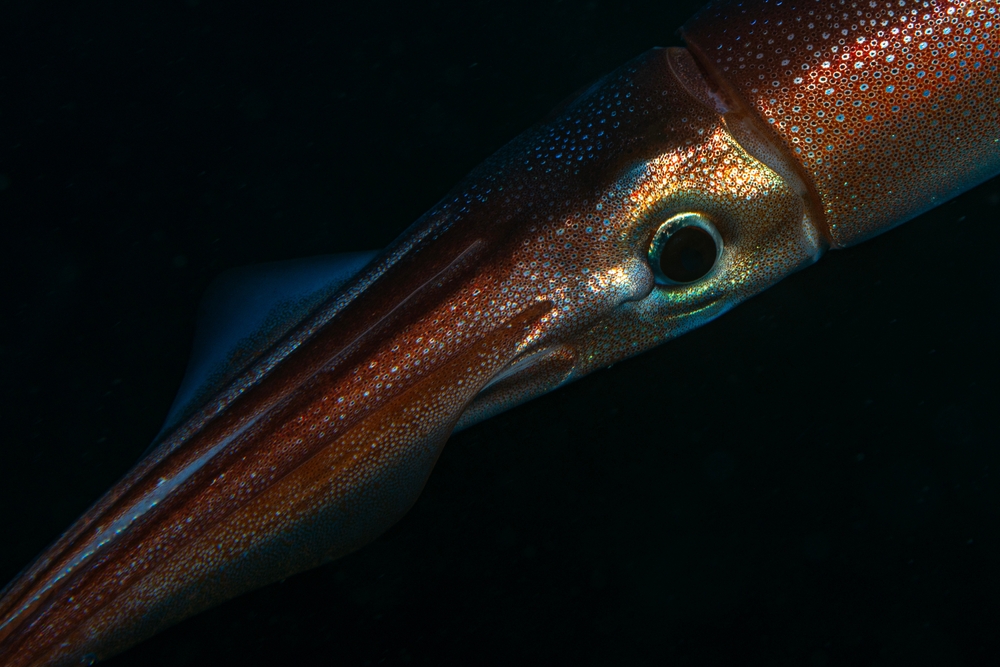
Image for illustrative purposes only. Credit: Shutterstock
The Stein incident quickly sparked speculation beyond the Navy, with discussions unfolding on cryptozoology forums, maritime blogs, and online communities about whether the frigate had encountered a real sea monster. Frequent references were made to the Kraken from Norse legend and Lovecraft’s fictional Cthulhu. Although these comparisons were entertaining, they lacked supporting evidence. The fragments analyzed by Wood proved to be genuine, recognizable, and biological, indicating they belonged to a known group of animals. The key question of the investigation was not whether an attack had happened, but which species was involved and its size.
What Sets the Colossal Squid Apart
The colossal squid (Mesonychoteuthis hamiltoni) belongs to a different biological family from the giant squid. The giant squid’s scientific name is Architeuthis dux. Scientists first described the colossal squid in 1925 from tentacle fragments found in a sperm whale’s stomach. For decades, it remained one of the least documented large animals on earth. In 1978, no complete adult specimen had been recovered for scientific study. Researchers knew the species existed. Its full anatomy and behaviour were still being assembled from fragments and indirect evidence. Wood’s identification of colossal squid hooks in the Stein’s dome was significant. It placed a barely documented species at the centre of a verifiable incident.
Hooks Built for Holding
Te Papa Tongarewa has published detailed anatomical studies of the colossal squid. Arm hooks are the most structurally significant feature for understanding the Stein damage. They sit in double rows along each arm, embedded in muscular sheaths. Each arm hook features a main claw with two smaller cusps at the base. This three-pointed design digs into a surface and holds it under pressure. The colossal squid uses these hooks against large animals, including sperm whales. The hooks can generate enough tearing force to shred organic tissue. This is the precise pattern Wood found in the NOFOUL coating. The hooks did not pull free. They broke and stayed.
The Heaviest Invertebrate on Earth
The colossal squid is the heaviest invertebrate known. The largest verified specimen, caught in Antarctic waters in the Ross Sea in 2007, weighed 495 kilograms and is now preserved at Te Papa. Scientists observed that the hooks were proportionally large relative to the animal’s total size, indicating that a mature adult of typical dimensions could produce hooks capable of tearing through industrial rubber. Therefore, a single, non-record-breaking squid could cause the damage described by Stein. The hook fragments recovered by Wood measured about 2 centimeters each, within the confirmed size range for this species.
The Evidence Points One Way
The fragments were confirmed to match the hook shape characteristic of a colossal squid. Their size, material, and shape aligned with documented features of the species, as no other marine animal is known to have hooks of this particular type and structure. Since the colossal squid lives in deep Pacific waters, this matched the USS Stein’s operational area. Wood’s conclusion was based on direct comparison with known biological specimens, leading him to identify the colossal squid as the source. This remains the most credible conclusion from the investigation, unaffected by later estimates.
Why Would a Squid Attack a Warship?
Large squid surface as they near death. When they weaken, they lose muscular control and drift upward from deeper waters. Their buoyancy relies on ammonium chloride solution distributed throughout their bodies. Upon death, this system fails, causing the squid to rise. Near the surface, a weak squid may cling to floating objects or ships for support. This has been observed; for instance, a giant squid wrapped its tentacles around a South African paddleboarder’s board off the coast. The squid was visibly injured and missing tentacles. It held onto the board before eventually releasing its grip and sinking.
Why the Dome Was a Target
A weakened large squid might have attached itself to the Stein’s sonar dome as the frigate sailed through the eastern Pacific. The NOFOUL rubber offered grip that bare metal or smooth hull surfaces do not provide. The squid’s hooks would have sunk into the coating on contact. As the ship advanced or the squid moved, the hooks would repeatedly tear through the rubber, with some breaking under shearing forces and remaining embedded. This process does not involve any unusual behaviour; it only requires proximity, surface contact, and a distressed animal seeking physical attachment support.
Sperm Whale Scars and Deep-Sea Confrontations
A second hypothesis draws on documented evidence from sperm whales. Sperm whales are the only known regular predators of the colossal squid. The Smithsonian Institution notes that many sperm whales stranded on beaches show large circular scars on their skin. Only one thing could have produced them: the suckers and hooks that line squid arms and tentacles. Older whales carry so many overlapping scars that individual marks become indistinguishable. The American Museum of Natural History has confirmed that these circular markings are consistent with encounters with giant and colossal squid. These confrontations occur regularly in the deep ocean.
A Case of Mistaken Identity
The Stein’s dome emerged from the bow as a smooth, rounded shape beneath the waterline. The AN/SQS-26 sent out strong acoustic signals while in active mode. A colossal squid at depth depends on its shape and vibrations to recognize objects. To a predator hunting sperm whales, the dome might have looked like a whale’s head. An attack or defensive move in this situation would align with typical behavior. Scientists have suggested that mistaken identity is one of the most plausible explanations for the encounter.
Range and Deep-Sea Distribution
The colossal squid mainly lives in the deep Southern Ocean. Large cephalopods have been found in Pacific waters, based on sperm whale stomach contents collected over a wide area. The eastern Pacific overlaps with the habitat of deep-sea squid species capable of producing hooks of this size. Marine biologists note that the precise distribution of the colossal squid is still uncertain. While the 1978 sighting in eastern Pacific waters cannot be definitively confirmed, it cannot be completely dismissed either.
The Stein Monster’s Legacy
The USS Stein did not end its service solely because of the sonar dome incident. The Navy repaired the coating, restored the sonar, and brought the frigate back into service. The Stein completed nine overseas deployments and circumnavigated the globe in 1987. It supported operations during the Iran hostage crisis, the Iran-Iraq War, and Operation Desert Storm. The Navy decommissioned the ship on March 19, 1992, after which she was transferred to the Mexican Navy as ARM Ignacio Allende.
From Naval Records to Popular Culture
Over the following decades, the case extended beyond naval archives. Cryptozoology websites treated the Stein Monster as an officially recognized encounter with an unknown creature. Some reports date the event to 1976 or 1977, while others overstated the damage or included unverified crew sightings. These additions are not present in the documented record. The basic facts are straightforward: a Navy frigate sustained damage from a sizable cephalopod, and a trained biologist confirmed the presence of hooks. The creature was never recovered nor definitively identified.
Read More: Seventeen “Conspiracy Theories” That Turned Out To Be Completely True
The Size Question Revisited
Size estimates for deep-sea cephalopods carry significant methodological challenges. No complete, living colossal squid was available for comparison in 1978. Measurements derived from hook fragments assume a fixed ratio between hook size and total body length. This method applies giant squid proportions to fragments more consistent with colossal squid anatomy. These two species do not share the same ratios. Colossal squid hooks are larger relative to their body size than giant squid hooks. Applying giant squid scaling to colossal squid fragments overstates total length. The scientific community treats the extreme size estimates from the Stein case as extrapolations rather than confirmed measurements.
What the Incident Tells Science
The Stein case holds a unique place in marine biology. It is well-documented, physically evidenced, and examined by experts, not folklore or legend. However, it remains unresolved, as no body, photos, or tissue samples beyond hook fragments have been found. The first live footage of a giant squid in its natural environment was captured in 2004, and the first adult colossal squid was recovered for study in 2007. The 1978 Stein encounter predates both milestones by nearly thirty years, involving a creature in waters still poorly understood and mapped by science. This highlights how much of the ocean’s deepest regions remain unexplored.
An Open Case in Deep Water
The USS Stein was repaired and returned to service. The creature that attacked it was not located. In 1978, deep-sea research lacked the means to pursue an animal retreating to depths of several hundred meters. Remotely operated vehicles for continuous deep-sea observation were not yet standard for scientific research. The investigation identified a probable biological cause and a likely species, but could not go further. The hooks stayed lodged in the rubber, and the animal disappeared back into the depths, unrecovered, unconfirmed, and unknown. The so-called Stein Monster remains one of the most unusual documented encounters between a naval vessel and a deep-sea animal.
Read More: 10 Celebrities That Are Still Alive (According to Conspiracy Theorists)
Trending Products

Red Light Therapy for Body, 660nm 8...

M PAIN MANAGEMENT TECHNOLOGIES Red ...

Red Light Therapy for Body, Infrare...

Red Light Therapy Infrared Light Th...

Handheld Red Light Therapy with Sta...

Red Light Therapy Lamp 10-in-1 with...

Red Light Therapy for Face and Body...

Red Light Therapy Belt for Body, In...

Red Light Therapy for Shoulder Pain...
