
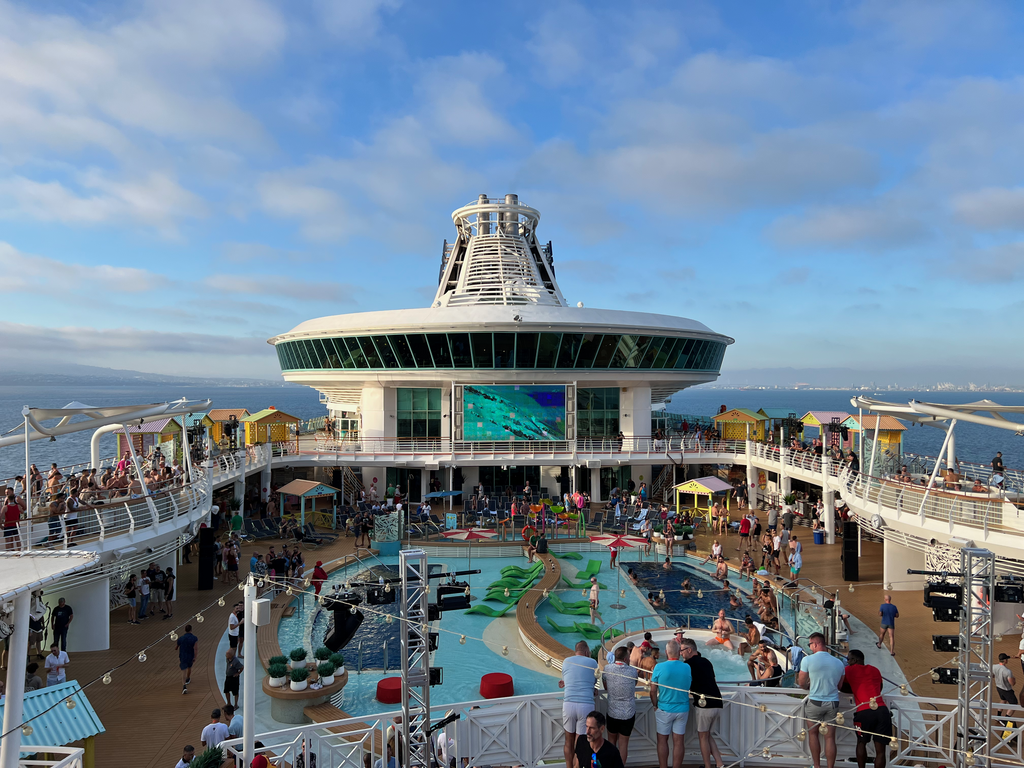
Michael Virgil was 35 years old when he boarded Royal Caribbean’s Navigator of the Seas on the morning of December 13, 2024. The Moreno Valley, California resident brought his fiancée, Connie Aguilar, their 7-year-old son, and other family members for a four-day trip to Ensenada, Mexico. The ship left the Port of San Pedro around 4 p.m., and Virgil’s death came less than 5 hours into the cruise.
Those who knew him have struggled to relate the man they loved to the behavior described in the incident reports from that evening. Something happened during those hours at sea, and after the Los Angeles County Medical Examiner ruled his death a homicide, Aguilar sued Royal Caribbean to find out how security guards restraining her fiancé led to his death.
Directed to a Bar
The Virgil family boarded the Navigator of the Seas around 11 a.m. and learned their cabin wasn’t ready. So the ship staff directed them to a bar area with live music to wait. Virgil had purchased Royal Caribbean’s Deluxe Beverage Package, an add-on that lets passengers order as many alcoholic drinks as they want throughout the voyage, one at a time. According to the lawsuit filed in the U.S. District Court for the Southern District of Florida, crew members served him at least 33 times over the next several hours, which works out to roughly one fresh drink every 15 minutes.
Their son has autism and grew restless waiting, so Aguilar took him to check on the cabin and left Virgil behind at the bar. Crew members kept serving him alcohol while he sat alone, drink after drink, even as he became visibly intoxicated. Royal Caribbean’s own policy gives bartenders the right to refuse service to anyone showing signs of impairment. But according to the lawsuit, no one did.
The ship sailed at 4 p.m. By then, Virgil had allegedly consumed enough alcohol to push his blood alcohol content between 0.182 and 0.186%, more than twice California’s legal driving limit. The autopsy later confirmed that no illegal or prescription drugs were in his system. The voyage was barely underway.
Lost on the Ship
The Navigator of the Seas has over a thousand staterooms spread across multiple decks. According to the complaint, Virgil tried to find his way back to the cabin and couldn’t, wandering the hallways and growing more frustrated with each wrong turn.
Fellow passengers began recording on their phones. Footage shot by passenger Christopher McHale and later obtained by KTTV Los Angeles shows Virgil in a corridor, yelling and kicking at a cabin door. He screamed profanities, threatened to kill a passenger and crew member who encountered him, and chased them down a hallway. The crew member locked himself in a towel room, and Virgil tried to kick that door open, too. An FBI investigator cited in the coroner’s report said Virgil also began removing ceiling panels from the ship and brandishing them as weapons.
None of this matched the man his family knew. Attorney Kevin Haynes later told FOX 11 Los Angeles that Virgil was known by his family as a gentle giant who wasn’t much of a drinker. Relatives had told the same outlet shortly after his death that his violent behavior was completely out of character. Attorney Anthony J. Russo Jr. told Newsweek that Virgil had no history of drinking or any violence. Whatever happened in the hours between boarding and wandering lost through the ship turned a routine vacation into something unrecognizable.
Security responded as his behavior escalated, and when guards arrived, Virgil was in no state to cooperate.
The Confrontation
Security guards tackled Virgil to the ground, and what followed, according to the lawsuit, was a sustained use of force against a man too intoxicated to pose a genuine threat.
Approximately 5 crew members held Virgil face-down on the floor with their full body weight, compressing his chest and back for roughly 3 minutes. The lawsuit describes a “prolonged prone restraint with multiple Royal Caribbean crew members applying compressive force to decedent’s back and torso, impairing chest expansion, limiting diaphragmatic motion, and obstructing venous return, leading to impaired breathing and hypoxia.” They bound his wrists with zip ties and handcuffs. And when he continued to struggle. They sprayed him with multiple cans of pepper spray.
The lawsuit argues that security staff should have recognized Virgil was impaired rather than dangerous and adjusted their response accordingly. Tackling an intoxicated, unarmed passenger and holding him down with multiple bodies while deploying pepper spray goes far beyond reasonable intervention, according to the complaint. Christopher McHale, the passenger who filmed part of the confrontation, later told KTTV that nobody deserved to die the way Virgil did. But the guards kept pressing down, and when physical force and pepper spray failed to calm him, they escalated further.
The Injection and What Came After
Medical staff arrived while security still had Virgil pinned to the floor, and at the Staff Captain’s request, they injected him with Haloperidol. It’s an antipsychotic medication typically reserved for patients experiencing severe psychiatric episodes like psychosis or extreme agitation. It works by sedating the nervous system, which also slows breathing and heart rate. Giving it to someone who is heavily intoxicated and being physically restrained is risky because alcohol already depresses respiratory function, and the weight of multiple bodies on a person’s chest makes breathing difficult even without drugs in the system.
The lawsuit argues that the ship’s medical personnel “lacked the proper education, licenses, training, experience and/or skills to work in an environment such as the vessel’s medical facility involving emergency and/or critical conditions.” No one apparently considered what would happen when a sedative entered the bloodstream of a man whose breathing was already compromised by alcohol, obesity, and the weight of several adults pressing him into the floor. According to the complaint, “the compression of DECEDENT’S body by ROYAL CARIBBEAN crew members, including security personnel, directly caused significant hypoxia and impaired ventilation, respiratory failure, cardiovascular instability, and ultimately cardiopulmonary arrest leading to DECEDENT’S death.”
Body camera footage showed Virgil still had a pulse and was still breathing after the restraint ended. He was pronounced dead roughly 2.5 hours after the incident began.
Three Days at Sea
Virgil’s body remained aboard the Navigator of the Seas for the rest of the voyage. Cruise ships don’t turn around when passengers die. The body goes to a morgue below decks, and the voyage continues on schedule. “They put Michael in a refrigerator and continued the cruise for multiple days,” attorney Kevin Haynes later said.
So Aguilar and her family spent three more days at sea while the ship sailed to Ensenada and back. She had to explain to their son why his father wasn’t coming back to the cabin, and why they couldn’t leave.
The Navigator of the Seas returned to Los Angeles on December 16, and the FBI confirmed shortly after that it had opened an investigation.
What the Autopsy Found
The Los Angeles County Medical Examiner conducted an autopsy and ruled Virgil’s death a homicide. The official cause was the combined effects of mechanical asphyxia, obesity, cardiomegaly, and ethanol intoxication. Meaning the weight of the guards on his body prevented his lungs from taking in enough air. The word homicide in a medical examiner’s report indicates that another person’s actions caused the death, though it does not necessarily mean a crime was committed.
Virgil’s body was already vulnerable before the restraint began. He stood 5’9″ and weighed 359 pounds. His body mass index was 49.3, which placed him in the severely obese category and meant he required more oxygen than most people, and his heart weighed nearly 20 ounces. Well above the normal range of 8 to 13.5 ounces for men. Making sudden cardiac failure more likely under physical stress.
His blood alcohol content measured between 0.182 and 0.186% three days after death, more than twice the legal limit. At that level of intoxication, breathing already becomes labored. Add the weight of multiple adults pressing down on his chest, the irritation of pepper spray in his airways, and the respiratory-depressing effects of Haloperidol, and the result was fatal. The autopsy showed a man whose body was already struggling before security ever arrived. Then, he was pushed past the point of survival by the intervention meant to control him.
A Second Death, A Similar Story
This is not the only recent wrongful death lawsuit against a Royal Caribbean cruise ship involving alcohol. In October 2024, less than two months before Virgil boarded the Navigator of the Seas, a 66-year-old woman named Dulcie White went overboard during a Taylor Swift-themed cruise.
Her family alleges that crew members continued serving her alcohol despite visible signs of extreme intoxication and that she fell from the ship as a result. That lawsuit makes similar claims about negligent overservice and failure to protect a vulnerable passenger. White’s body was never recovered.
The Virgil lawsuit argues that Royal Caribbean deliberately designs its vessels with alcohol-serving stations throughout and does as much as possible to encourage drinking on board. A single passenger buying the unlimited package generates roughly $400 in guaranteed revenue on a four-day cruise. And that money comes in whether the passenger drinks responsibly or not.
Cruise lines operate under maritime law. This requires carriers to supervise and assist passengers who may engage in behavior dangerous to themselves or others. Both lawsuits argue Royal Caribbean failed to meet that standard. Russo told Newsweek that the company “grossly and egregiously violated” its own policies.
An Open Investigation
The FBI’s Los Angeles field office is investigating Virgil’s death. This is standard procedure when someone dies in a maritime jurisdiction, where legal authority gets complicated because the incident occurred at sea rather than on U.S. soil. The bureau has not indicated whether criminal charges might follow.
The wrongful death lawsuit seeks unspecified damages and a jury trial. The family is also pursuing punitive damages. Arguing that Royal Caribbean’s conduct was willful and outrageous. A higher bar than ordinary negligence that signals they’re pushing for more than compensation. Under the Death on the High Seas Act, they’re seeking recovery for lost support, lost inheritance, past and future earnings Virgil would have provided, and funeral expenses. For the survivors, they want damages for lost companionship, mental pain and suffering, and loss of nurture and guidance.
Cases like this often take years to resolve, and cruise lines typically have substantial legal resources to defend themselves. Royal Caribbean is incorporated in Liberia, a flag-of-convenience arrangement that can affect which laws apply and how litigation proceeds. The family’s attorneys will need to prove that Royal Caribbean’s negligence directly caused Virgil’s death by drawing a clear line from the drinks to the restraint to his final breath.
The complaint makes one more point worth noting. Alcohol is banned for safety reasons aboard U.S. government and military vessels, as well as U.S.-flagged merchant ships. Royal Caribbean operates under no such restriction.
Read More: 10 Things You Should Avoid Eating on a Cruise
The Company Responds
Royal Caribbean issued a statement shortly after Virgil’s death. “We are saddened by the passing of one of our guests,” the company said. “We offered support to the family and are working with authorities on their investigation.” The company has not commented publicly on the specific allegations in the lawsuit.
Aguilar is not waiting for industry reform. She is pursuing accountability through the courts. Hoping that a successful lawsuit might force Royal Caribbean to reconsider practices she believes put revenue ahead of safety. “The bottom line is that they need to pay for what they did to this family and they need to take accountability,” Haynes told FOX 11 Los Angeles. “The only way to do that is through a lawsuit. They’re never gonna self-correct on this.”
This is the second wrongful death lawsuit in recent months accusing Royal Caribbean of over-serving a passenger who later died. One case is a tragedy. Two suggests something systemic.
For Aguilar, the goal is both justice for the man she lost and protection for passengers who board these ships expecting a vacation. Michael Virgil stepped onto the Navigator of the Seas on a December morning with his family beside him. He never stepped off.
Read More: 10 Cruise Ship Features You Had No Idea Existed
Trending Products

Red Light Therapy for Body, 660nm 8...

M PAIN MANAGEMENT TECHNOLOGIES Red ...

Red Light Therapy for Body, Infrare...

Red Light Therapy Infrared Light Th...

Handheld Red Light Therapy with Sta...

Red Light Therapy Lamp 10-in-1 with...

Red Light Therapy for Face and Body...

Red Light Therapy Belt for Body, In...

Red Light Therapy for Shoulder Pain...
