Jennifer Aniston is 56 and in the best shape of her life, and the reason isn’t what you’d guess. It’s not a secret supplement or a celebrity trainer or some punishing two-hour gym session. It’s a 30-minute workout, done consistently, built around movements that protect her body instead of wearing it down.
For most of her career, she trained the way Hollywood expected her to. She ran, she boxed, she ground through long cardio sessions that stretched past 45 minutes and sometimes well beyond an hour. That was the formula for staying lean, and she followed it for years, until the aches started to linger and recovery dragged on longer than it should.
She told TODAY in April 2025 that she “really destroyed” her joints from running and boxing because she would “personally go too hard,” and that a back injury from harness work on a film set in 2021 was the moment she stopped ignoring what her body had been telling her for years.
By October 2025 she was fronting Pvolve’s Strong for Fall Challenge. A three-week campaign that asked members to complete 10 strength workouts and donated to Women in Medicine for every person who finished. Funding research aimed at closing the very gaps in women’s health science that left her, and millions of women like her, training off guidelines built almost entirely on male data.
That kind of candor from a celebrity is rare. But Aniston’s story connects with so many women because it mirrors something millions of them are living through right now. After years of being told that fitness means going harder, running farther, and sweating longer. A lot of women in their 40s, 50s, and 60s are realizing the formula they followed was never built for them in the first place.
The research bears this out. The American Physiological Society has written that despite women making up nearly half of all athletes, scientific research hasn’t kept pace. Which means most of what we know about training, injury prevention, and recovery was drawn from data on men and then applied to women. A 2021 review led by Emma Cowley and colleagues, published in the Women in Sport and Physical Activity Journal, shows just how lopsided that imbalance is.
They audited over 5,200 publications across six major sport and exercise science journals from 2014 to 2020 and found that only 6% focused on women exclusively. Out of more than 12 million total participants across those studies, just 34% were female.
Jennifer Aniston’s trainer, Dani Coleman, introduced her to Pvolve, a functional strength method that focuses on movements your body actually performs in real life. Rather than isolating muscles the way gym machines do. Coleman, who spoke to HELLO! Magazine about training Aniston for more than four and a half years, said one constant in every session is core work because of the 2021 back injury. “We do a lot of core work to help protect her spine,” Coleman explained, adding that Aniston loves Pvolve because “she can do this workout and not inflame those old injuries.”
Aniston has also talked about having to unlearn the idea that exhaustion equals results. That more is always better. And that rest is lazy. For women who spent decades believing a workout only counts if it hurts. Watching someone like her thrive on something gentler makes the switch feel less like quitting and more like growing up. She says she’s now injury-free and in the strongest shape she’s ever been. Which is a bold claim from someone who’s been training seriously for over 30 years.
Inside the Routine
Aniston and Coleman have shared enough about their sessions, including in a Pvolve campaign video, that the structure is well documented. Coleman has said that some days it’s a full hour and other times it’s a quicker 30-minute session. Depending on Aniston’s schedule and energy. A typical Pvolve session combines resistance bands, small weights, and gliders with multi-directional movements that flow from one exercise to the next without long rest breaks. So heart rate stays moderately elevated throughout. You’re building strength and working on balance while also getting cardiovascular benefit. Which is why the whole thing feels like strength training, Pilates, and physical therapy compressed into a single window.
The work moves through the whole body. Slow squats and lunges target the glutes and thighs without heavy load on the knees or hips, and rotational core work strengthens the waist and lower back between those efforts. Standing leg lifts and balance drills train the small stabilizing muscles around the ankles and knees. Upper-body sequences use light weights or resistance bands to work the shoulders, arms, and upper back. Short mobility flows keep the hips and spine moving freely between the harder efforts, and everything is stitched together so there’s no standing around.
Most gym exercises happen in a single plane, forward and back or up and down. But real life asks your body to rotate, reach sideways, and maintain a balance on uneven surfaces. A leg press doesn’t train any of that. Pvolve’s movements work all of those ranges. Building strength that carries over into how you move through your day rather than just how you perform in a gym.
Aniston told TODAY her current favorite format within Pvolve is called “sculpt and burn,” which blends cardio with low-impact strengthening. She likes starting with a heart-opening pose, then moving into a staggered stance and twisting to warm up the joints before the harder work begins. The equipment stays minimal. She always travels with a bag of lightweight Pvolve gear so she never has to miss a session on the road.
Thirty minutes sounds short, but the research says it’s more than enough. A study published in the European Heart Journal found that as little as 15 minutes of vigorous activity per week, broken into bouts as short as 2 minutes each, was associated with an 18% lower risk of early death. While 20 minutes per week was linked to a 40% lower risk of cardiovascular disease mortality. Aniston trains 3 to 5 times per week, and that consistency is where the results come from.
Coleman told HELLO! that when Aniston walks in low on energy and says something like “Oh my goodness, we have to do this?!” She shifts gears. Puts on a good playlist. Gets the dogs in the room. And moves alongside her to get things going. That flexibility is what keeps someone showing up week after week instead of skipping it.
What Happens to Women’s Muscles After 50
When estrogen declines during and after menopause, women lose muscle tissue faster than at any other point in their lives. Resistance training is one of the few interventions that can slow it down. That’s the real case for training the way Aniston does. It has more to do with health than how any of it makes her look.
A paper published in the journal Climacteric in July 2024 gave this a name. The authors introduced the term “musculoskeletal syndrome of menopause” to describe the cluster of symptoms that estrogen loss triggers. They reported that more than 70% of women experience them through the menopause transition. A quarter will be disabled by them.
The symptoms range from joint pain and bone density loss to shrinking lean muscle mass, increased tendon and ligament injuries. And the progression of osteoarthritis. Because the damage is hormonal rather than structural, it often won’t show up on an X-ray or MRI. Which means doctors frequently dismiss or undertreat it.
Researchers at the University of Minnesota traced the mechanism to muscle stem cells called satellite cells. Which allow muscle tissue to repair and rebuild itself but require estrogen to function in females. When estrogen drops, those cells begin to disappear. Professor Dawn Lowe’s team showed this first in mice whose ovaries were removed, where satellite cell populations plummeted, and leg muscles recovered poorly after minor injury.
When estrogen was restored, both conditions reversed. The human evidence came from a collaboration with Finnish scientists who took muscle biopsies from women shortly before and after the menopause transition. They found that satellite cell numbers fell in lockstep with estrogen levels. “This is the first work to show that estrogen deficiency affects the number as well as the function of satellite cells,” Lowe said in the study, which was published in Cell Reports.
So after menopause, women’s muscles have a diminished ability to repair and rebuild. The joint pain, the weakness, and the slow recovery aren’t just aging. They’re consequences of a specific hormonal shift. A March 2025 study published in Menopause, the journal of The Menopause Society, found that the resulting decline in muscle mass and function raises the risk of frailty, diabetes, malnutrition, and mortality. Dr. Stephanie Faubion, the Society’s medical director, stated that all midlife women should be working to mitigate that loss through regular resistance training and adequate dietary protein.
This is the kind of work that shows up in every Pvolve session. Slow squats and lunges build glute strength without heavy load on the joints, rotational core work stabilizes the spine, and standing balance drills challenge the small muscles around the knees and ankles. It’s not glamorous. But it addresses what menopause takes away.
What the Guidelines and the Trials Say
The National Institute on Aging recommends that older adults combine aerobic activity, muscle-strengthening work, and balance training every week. In practice, that means at least 150 minutes of moderate-intensity aerobic exercise, muscle-strengthening activities on at least 2 days. And roughly 3 sessions of balance work.
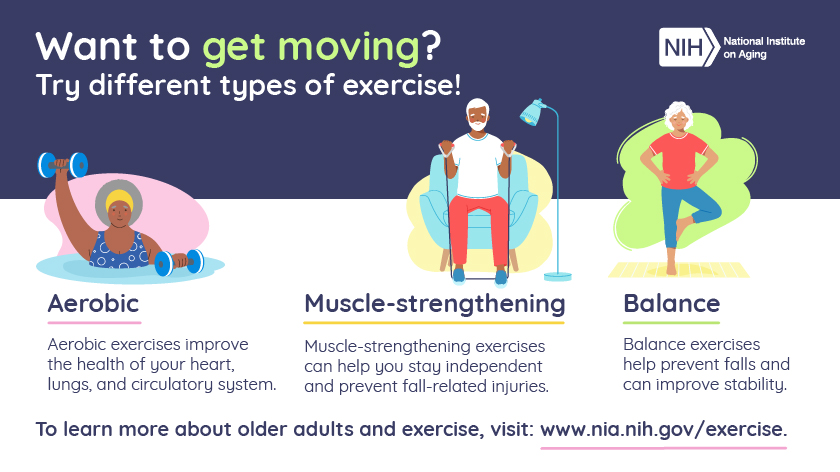
The reason the NIA emphasizes all three is that no single type of exercise covers everything on its own. Walking helps your heart but doesn’t build bone density. And lifting weights builds muscle but doesn’t train the stabilizing systems that keep you upright. You need the combination, and Aniston’s Pvolve sessions fold all 3 into a single window.
Strength training gets special attention in the NIA’s guidelines because adults lose muscle mass steadily after their 30s, and inactivity speeds that loss. When muscles shrink, the body burns fat more slowly, which raises inflammation. Which aggravates arthritis and other conditions that make movement painful. Over time, each piece makes the next one worse, and the cycle feeds itself until something interrupts it. Resistance training is one of the most reliable ways to do that.
Women face an even steeper version of this because their baseline muscle levels already trend lower. So the squats, lunges, and lower-body resistance work built into every Pvolve session aren’t just general fitness moves. They’re targeted prevention for the kind of joint and hip problems that sideline women as they age.
Falls are the leading cause of injury among adults over 65. Research consistently shows that regular balance exercises can cut fall rates by nearly a quarter. Most people think of balance training as something you do in physical therapy after an injury. But the NIA recommends it as a preventive measure. Which is why the standing leg work and glider movements in Pvolve matter. They train the small stabilizing muscles around the ankles and knees during the same session that’s already building strength and elevating heart rate. So balance becomes part of the routine rather than a separate appointment.
Cardiovascular fitness matters for reasons most people don’t associate with cardio. Without it, daily tasks become harder over time, people stay home more, and they socialize less, which accelerates cognitive decline. Research published in JAMA Network Open in 2025 found that people who were most physically active in midlife had a 41% lower risk of developing dementia. That finding adds real urgency to the aerobic component of any training program. Aniston’s sessions keep her heart rate elevated throughout. Which addresses that without the long runs that used to wear down her joints.
The University of Exeter put the full combination to the test. Their Healthy Aging Study recruited 72 women aged 40 to 60 and tracked them over 12 weeks. Comparing those who followed the Pvolve method four times per week to a control group following standard exercise guidelines. The Pvolve group showed a 19% increase in hip function and lower body strength, a 21% improvement in full-body flexibility, and a 10% gain in balance, mobility, and stability.
They added lean muscle without increasing total body mass, and their blood lipid levels dropped. Perimenopausal participants showed measurable decreases in cholesterol and triglycerides. And since cardiovascular risk climbs during that transition, those numbers carry weight well beyond the gym. The study was funded by Pvolve and published in Medicine & Science in Sports & Exercise.
What the Exeter data confirmed is that you don’t need three separate routines to get the benefits the NIA recommends. One method, done consistently, covered all of it. For someone whose shift toward this kind of training began with a back injury. The science validates a choice Aniston made years before the clinical evidence existed.
Beyond the 30 Minutes
Jennifer Aniston follows what she calls an 80/20 rule. Building most of her meals around protein, vegetables, and water, then eating whatever she wants the other 20% of the time. It’s not a trendy diet, and she’s the first to say so. But after 50, simple consistency with protein may be more valuable than any single workout.
Research published in the Journal of Nutrition, Health and Aging found that among adults aged 71 and older, up to 46% aren’t meeting their daily protein needs. The standard recommendation of about 0.36 grams per pound of body weight per day may not be enough to protect aging muscle. Studies on older adults have shown that intakes closer to 0.45 to 0.55 grams per pound do a better job of preserving lean mass and strength. Which is why the Menopause Society’s 2025 recommendation specifically called out adequate dietary protein alongside resistance training.
After menopause, when declining estrogen has already weakened the body’s ability to repair muscle tissue. Protein becomes the raw material that makes that repair possible. Aniston has said she prioritizes it at every meal. That habit may be doing as much for her strength as any single exercise in her routine.
Sleep is the part she says she struggles with most, but she treats it as seriously as the training itself, and for good reason. Muscle tissue doesn’t rebuild during the session. It rebuilds during deep sleep. When the body releases growth hormone and directs amino acids from the protein you ate into repairing the muscle fibers you broke down.
Cut that window short, and the work you did in your routine doesn’t fully take hold, which is why even the best routine will stall without enough rest. Hydration plays into the same process. Water carries nutrients to muscle cells, lubricates the joints that resistance training loads, and helps flush the metabolic waste that builds up during exercise.
Without enough of it, recovery slows, and joints stiffen before you ever feel thirsty. She also builds yoga and meditation into her week, even if it’s only 10 minutes on busy days. For women in midlife, elevated cortisol can interfere with sleep, promote fat storage, and slow recovery. That kind of deliberate downshift is what makes consistent training sustainable over years instead of months.
None of this is extreme. Aniston eats simply. Sleeps as well as she can. Moves for 30 minutes a few times a week. And rests when her body asks for it. She’s 56, injury-free, and says she’s in the strongest shape of her life. The Exeter trial, the NIA’s framework, and the emerging research on menopause and muscle loss all point in the same direction she’s already walking. Millions of women have spent decades hearing that fitness has to hurt to count. That might be the most useful thing she’s ever shared.
Read More: Jennifer Aniston, 55, reveals her tricks to look as good as she did in her 20s
Trending Products

Red Light Therapy for Body, 660nm 8...

M PAIN MANAGEMENT TECHNOLOGIES Red ...

Red Light Therapy for Body, Infrare...

Red Light Therapy Infrared Light Th...

Handheld Red Light Therapy with Sta...

Red Light Therapy Lamp 10-in-1 with...

Red Light Therapy for Face and Body...

Red Light Therapy Belt for Body, In...

Red Light Therapy for Shoulder Pain...
