Health scares spread fast when they reduce a complicated issue to one simple claim. That is what happened when LADbible highlighted comments from Ed Jones, founder of Nutrition World, about grip strength and lifespan. In that version, Jones said people could learn something important about future health from a simple strength challenge. He linked the idea to longevity physician Peter Attia and described grip as a test many doctors never ask about. The hook worked because it sounded direct and easy to try at home. Yet the evidence behind the claim is more careful than the headline suggests. Grip strength does matter. It has been tied to mortality, frailty, mobility, and cognitive decline. Even so, the research does not support a pass or fail verdict after one homemade stunt with a heavy dumbbell.
The stronger version of the story is still worth attention. In 2024, Lirong Chai, Dongfeng Zhang, and Junning Fan published a relevant paper in Scientific Reports. They found that lower grip strength tracked with higher all-cause mortality risk in U.S. adults. The same paper found that simple grip measures worked as well as more adjusted formulas. That gives grip strength real value as a quick marker of health and function. It does not make it a crystal ball. The study did not test Jones’s viral dumbbell challenge. It also did not claim that failing one informal task guarantees a shorter life. A balanced reading is more useful. Weak grip can signal reduced physical reserve, worsening muscle function, or broader decline across the body. It should prompt attention, not panic.
The Viral Grip Test
Ed Jones did not appear from nowhere. Nutrition World says he founded the company in 1979. The business still presents him as its founder and longtime public voice. LADbible described him as the health expert behind the viral warning. It also traced the claim to his Nutrition World Podcast with his daughter, Cady Kuhlman. That background gave the story a ready-made frame. A founder with decades in wellness sounds credible to casual readers. Many people will trust that voice before they see any data. The article also tied Jones’s remarks to Peter Attia. Attia’s work on aging, strength, and lifespan already had a large audience. That made the message easier to spread across podcasts and social media. Then the story added a simple challenge.
Jones said a person who could not manage the task would “die earlier” than a stronger person. That phrase is brutal. It is also perfect fuel for a viral health clip. People click when a health claim sounds personal, measurable, and urgent. Stories built that way often outrun slower, better explanations. The format also flatters the audience. It suggests that secret knowledge was hiding in plain sight. It turns a daily function into a dramatic test of destiny. That mix can make weak evidence look bold and settled. The appeal also comes from what grip strength represents in daily life. It sounds ordinary, yet it touches many basic tasks. People use grip when they open jars, carry shopping bags, lift a suitcase, or grab a rail.
Those actions call on wider strength, balance, and coordination. Cleveland Clinic geriatric specialist Dr. Ardeshir Hashmi says people who maintain grip strength “age more slowly.” That line is short and memorable. It is also grounded in a real clinical idea. Grip can act as a quick sign of how much muscle and function a person still has. A weak grip can show up long before a person sees it as a medical issue. That makes it easy to frame as a hidden test of longevity. It also fits a public appetite for simple health scores. Many people want one number, one hack, or one challenge. Real health rarely works that way. Grip strength may deserve more attention in routine care. Yet even a useful marker has limits. It can raise a flag, but it cannot tell the whole story alone.
A strong grip does not erase other risks. A weak grip does not prove an early death. The real value lies in what the signal invites next. It pushes people to look harder at function, illness, muscle loss, and daily capacity. The message also benefited from a familiar health culture. Many people now follow podcasts that promise a longer life through daily habits. In that setting, a grip challenge sounds practical and modern. It asks for action, not patience. It also lets people sort themselves quickly into strong or weak. That is emotionally powerful. Yet speed can create false confidence. A fast result may seem precise even when it is rough. That helps explain why the claim traveled beyond wellness circles. It offered fear, simplicity, and control in the same package.
The 2024 Study Behind the Mortality Claim
The study most often used to support this claim was published in Scientific Reports in November 2024. It was led by Lirong Chai, Dongfeng Zhang, and Junning Fan. The researchers used data from the 2011 to 2014 National Health and Nutrition Examination Survey, or NHANES. They included 9,583 adults aged 20 and older after exclusions. Grip strength was measured with a digital handheld Takei dynamometer. Participants stood and squeezed as hard as possible. They repeated the test 3 times in each hand. The team then linked those measurements to the National Death Index. They followed outcomes through 31 December 2019.
Over a median follow-up of 6.75 years, 805 deaths occurred. That design gave the researchers a large national sample. It also gave them a standardized way to assess grip. Those features make the paper useful. They also show why the viral retelling drifted away from the real study. The paper tested dynamometer readings under controlled conditions. It did not test an improvised dumbbell hold at home. That distinction matters because the two tasks stress the body differently. One measures hand force in a controlled way. The other adds posture, shoulder endurance, and technique. When the task changes, the meaning can change too. The findings were still striking.
All 5 grip measures in the study showed inverse associations with all-cause mortality. In plain language, lower grip strength was linked with a higher risk of death during follow-up. The simplest measures did especially well. Average handgrip strength and height-adjusted grip both reached an area under the curve of 0.714. Maximum grip strength followed closely at 0.712. The strongest association appeared in the “lowest 20% grip strength group.” The hazard ratio there reached 2.20 for men. It reached 2.52 for women. The paper also reported that every 5-kilogram drop in average grip strength raised the hazard by 36% in men. The comparable increase in women reached 49%. Those numbers explain why the paper drew attention outside academic circles. Yet the authors did not present grip as destiny. They wrote that “residual confounding still exists.” In simple terms, other factors may still shape the result.
They also studied all-cause mortality, which combines many causes of death into one outcome. That makes the signal broad, not precise. The paper also compared several ways to express strength. Some measures adjusted the grip for height, weight, body mass index, or waist size. Others used raw strength values. The simplest measures performed very well. That result matters for clinics and public health work. It suggests a basic grip test can still provide meaningful information. The paper’s practical message was easy to miss under the viral noise. Researchers were not hunting for a stunt. They were testing which grip measure best predicted later mortality in a large dataset. The paper shows that grip can help identify risk. It does not show that one informal challenge can predict any person’s exact future. Few tests offer that mix of simplicity, cost, and scale.
Grip Strength as a Clue to Overall Health
Grip strength draws attention because it often points beyond the forearm. Cleveland Clinic describes it as an easy measure of how strong the rest of the body is. That idea matches a wider body of research. In a 2019 review in Clinical Interventions in Aging, physical therapist Richard W. Bohannon wrote that grip strength has been suggested as a biomarker of aging. He also summarized evidence linking grip with overall strength, fractures, falls, malnutrition, depression, diabetes, sleep problems, cognition, and mortality. In that review, grip strength also predicted future function, hospital problems, and disease-specific death in several settings. That range matters. It suggests that grip is not just a hand issue. It often reflects the health of muscles, nerves, movement, and reserve across the body.
When those systems weaken, the hands often reveal it early. That helps explain why clinicians keep returning to this measure. It is quick, cheap, and easy to repeat over time. It can sit beside other tests without much cost or effort. A good marker does not answer every question. It helps identify who needs a closer look. Grip strength fits that role well because it captures function in a direct way. Bohannon’s review also noted links with quality of life in many studies. That point helps move the issue beyond mortality headlines. People do not only want longer lives. They also want mobility, autonomy, and less dependence. The same logic reaches into brain health and independence.
The National Institute on Aging says older adults with weaker handgrip were more likely to be cognitively impaired. That finding came from an NIA-funded study. The institute added that grip may be “a potential low-cost, easy way” to help detect impairment. It should still be used with other measures. That final point is important. Grip works best as part of a bigger picture. It does not replace clinical history, lab work, gait testing, imaging, or cognitive screening. Cleveland Clinic also links a weak grip with lower mobility, frailty, falls, fractures, and chronic disease risk. Dr. Hashmi explains that muscle loss across the body often shows up in the hands, too.
His explanation centers on sarcopenia, the age-linked loss of muscle tissue and function. That concept helps make the evidence easier to understand. A weaker hand can reflect weaker legs, poorer balance, and lower resilience after illness. It can also signal reduced ability to recover from stress. Seen that way, the hand acts like a dashboard light. It does not tell you the whole problem. Yet it can show that something important deserves a closer look before larger trouble appears. Bohannon’s review also helps here. It shows that grip strength often lines up with daily function in real life. That is one reason grip has value in aging research. It offers a simple doorway into harder questions about reserve, recovery, and function. Those are the same issues that often decide whether a person stays independent as the years pass. It can also matter before obvious disability appears.
When a Viral Health Claim Pushes Past the Evidence
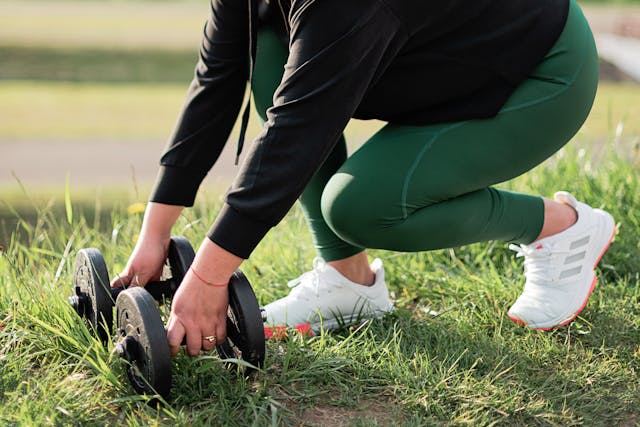
The public claim became shaky when it moved from marker to verdict. Jones’s viral version described a 1-minute dumbbell hold at 75% of body weight. The Scientific Reports paper did not test that challenge. It also did not compare a dumbbell hold with cholesterol tests or other standard measures. The authors were comparing different ways to express grip strength within one dataset. They were not staging a contest between grip and every blood test. That is a major difference. A hand dynamometer measures maximal squeeze force under a standard protocol. A heavy dumbbell hold adds posture, shoulder stability, pain tolerance, hand size, training background, and technique.
Two people could post similar dynamometer results and still perform very differently in a loaded hold. A reader would never know that from the viral headline. That is how public health claims get distorted. A broad idea from science gets compressed into a dramatic challenge. Then the challenge gets treated as if the paper tested it directly. That never happened here. The science supports grip strength as a marker of health. It does not support a homemade pass or fail test of lifespan. Another issue is safety. A very heavy dumbbell hold may be unrealistic or risky for some people. Older adults, beginners, and people with pain may strain the wrist, shoulder, or back. A dynamometer is safer and more controlled.
The research also comes with limits that dramatic stories rarely stress. This was an observational study, so it cannot prove that a weak grip directly causes earlier death. The authors adjusted for many confounders. Yet they still stated that “residual confounding still exists.” They also relied on baseline grip measurements. That means the study did not track how changes in strength over time might alter risk. A person who later improved strength would still be counted from the earlier baseline. The outcome was all-cause mortality, which is broad and useful, but still blunt. It does not explain whether the stronger link came through frailty, illness burden, inactivity, poor nutrition, smoking, or other pressures. Bohannon’s review points in the same direction. Grip is valuable because it predicts outcomes across many settings.
That does not mean it acts alone or explains every outcome. Public challenges often skip that point. They make a hard task look universal. In reality, the best test fits the person and yields a useful reading without extra risk. Used well, grip is a warning flag. Used badly, it becomes a scare line that promises more certainty than the evidence can deliver. That is why balanced wording matters so much in health writing. A useful signal can still be oversold. Once that happens, readers may leave with fear instead of practical insight. That is especially important in public health messaging. A challenge that scares people may spread faster. It may also confuse people who need a proper assessment. That is another reason the viral version went too far. It replaced a measured finding with a sweeping claim about personal fate.
Read More: How Aging Speeds Up After 40 and 60 — Experts Share Lifestyle Tips to Keep You Healthier Longer
A More Useful Way to Think About Longevity
A smarter use of this information starts with context. If grip strength is dropping or ordinary lifting tasks are getting harder, that change deserves attention. It may reflect less activity, muscle loss, poor recovery after illness, arthritis, nerve problems, or lower physical reserve. A clinician or physiotherapist can measure grip with a proper dynamometer. They can compare the results with age, sex, body size, symptoms, and daily function. They may also assess walking speed, balance, rising from a chair, recent weight loss, pain, and disease history. That kind of review turns a frightening headline into something practical. Grip belongs with other useful markers of aging, not above them. Cleveland Clinic puts the issue plainly when Dr. Hashmi links reduced grip with frailty and other complications.
That is serious, yet it is still a call to investigate, not a final sentence. The best value of grip testing lies in early detection and course correction. It can help uncover sarcopenia, deconditioning, poor nutrition, or untreated illness. It can also reassure people who worry after seeing viral clips. The right question is not whether one challenge predicts death. The right question is whether declining strength points to something fixable. That shift changes the whole tone of the discussion. It moves the reader from fear toward action. That is where useful health writing should aim. It can also guide timely conversations with doctors, trainers, or physiotherapists. It can help families notice change earlier, before falls, fatigue, or loss of independence become harder to ignore. Early action almost always works better than delayed action.
The good news is that the broad response does not require gimmicks. The CDC says physical activity is “one of the most important things” adults can do for health. Its guidance advises adults to get at least 150 minutes of moderate activity each week. It also advises at least 2 days of muscle-strengthening activity. The World Health Organization gives similar advice. It says adults should strengthen major muscle groups on 2 or more days each week. That guidance fits this topic well because a stronger grip usually grows from whole-body training. Carrying loads, lifting weights, rowing, climbing stairs, and gardening can all help preserve muscle and function.
Whole-body strength work also supports bone health, balance, glucose control, and independence. The practical advice is less mysterious than the headline. People do not need a secret protocol. They need steady habits that preserve muscle over time. That may include resistance training, loaded carrying, walking, rising from the floor, or supervised rehabilitation after illness. Small, repeated gains can matter. The goal is durable function, not a 1-minute stunt. Jones was right about one broad point. Strength tells a meaningful story about future health. The science simply asks for a calmer ending. That is a more realistic route to healthier aging. It is also a more honest one. That kind of plan can be adapted for age, pain, injury, or chronic illness. It gives people a safer path than testing themselves with extreme loads.
A.I. Disclaimer: This article was created with AI assistance and edited by a human for accuracy and clarity.
Read More: Dick Van Dyke, 99, Shares Two Habits to Avoid for Longevity
Trending Products

Red Light Therapy for Body, 660nm 8...

M PAIN MANAGEMENT TECHNOLOGIES Red ...

Red Light Therapy for Body, Infrare...

Red Light Therapy Infrared Light Th...

Handheld Red Light Therapy with Sta...

Red Light Therapy Lamp 10-in-1 with...

Red Light Therapy for Face and Body...

Red Light Therapy Belt for Body, In...

Red Light Therapy for Shoulder Pain...
