
Learning road signs can seem like a one-time job. People cram for a test, then drive for years on habit. Yet signs change, routes change, and memory fades. Some symbols also ask drivers to supply context fast. A sign might tell you a rule, but not the exact number, lane, or hazard. That gap is where confusion starts, and small mistakes can turn into big ones. This guide focuses on one UK sign that many drivers misread. It then adds four more signs that also trip people up. Each section explains what the sign means, why drivers misinterpret it, and what to do next.
The goal is simple. Leave with a clear action for the next time you meet the sign, day or night. If you drive abroad, rules can differ, so check local guidance. If you drive for work, refresh the basics once a year. Small review sessions beat last-minute cramming. A few minutes with official manuals can prevent a ticket or a crash. In the UK, the Highway Code and Department for Transport guides show the symbols and the rules behind them. In the United States, the MUTCD sets national standards for signs and markings. These documents are not thrilling, yet they remove guesswork. They also use careful wording, because the meaning of a sign has legal weight. Online debates can be entertaining, but they can also spread myths. Official sources cut through that noise. They also help you notice when a sign applies to your vehicle class, not only cars.
The UK National Speed Limit Applies Sign
The white circle with a single black diagonal stripe is common in the United Kingdom. Drivers see it after roadworks, after a lower local limit, or as they leave a village. The sign does not show a number, which is why it confuses people. It is not a request to guess. It is a reset to the national rules for that road type and vehicle class. The UK government states that “The national speed limit for the type of road and class of traffic applies.” That sentence is simple, yet it carries a hidden task. You must identify the road category and your vehicle category before you pick a speed. If you skip that step, you risk speeding without realizing it.
Start with the road. Built-up roads with a system of street lighting usually default to 30 mph, unless signs say otherwise. Street lights alone are not a speed sign, yet they often signal a restricted area. Look for repeaters if the road has no lighting, because limits can change quickly. Outside built-up areas, the default for cars is usually 60 mph on single carriageways and 70 mph on dual carriageways and motorways. To tell road types apart, look for a central reservation or barrier. A painted line is not a reservation, while a grass verge or concrete divider is. If junctions and driveways appear on both sides, it is often a single carriageway. Your vehicle can change the limit again. Vans, heavy goods vehicles, and vehicles towing trailers often have lower national limits on the same road.
The sign also ends any temporary restriction you were following, unless another sign keeps it in place. This is why it appears at the end of roadworks. It tells you the special limit has finished. Yet the safest way to use it is to treat it as a legal ceiling, not a goal. Choose a speed that matches sight distance, junctions, weather, and traffic flow. On a narrow country lane, 60 mph might be legal for a car, yet still unsafe. On a fast A-road, 60 mph can be reasonable when visibility is clear. If you are unsure of the road type, slow down until you can confirm it by layout, markings, and later repeaters. On some routes, a short dual section can appear between junctions. A central barrier and opposing lanes separated by it usually signal a dual carriageway.
If the road has one lane each way with only a painted line, treat it as a single carriageway. If you are towing, give yourself more space for stopping, especially downhill. Additionally, if you drive for work, learn your vehicle class limits and keep them in mind. Many fleets place a small card on the dashboard for quick reference. Remember that national limits can be different for cars, car-derived vans, and larger goods vehicles. If you are towing, assume you need more time to slow; therefore, start easing off earlier. Speed cameras and average speed zones do not change the limit, yet they remove doubt about enforcement. Also watch for variable signs on motorways, because they override the default when lit. The national symbol still means the default applies once those signs end. The sign expects you to know the rules, even if the road is new to you.
Left Turn Yield on Green
Many drivers learn a simple rule: green means go. Intersections can make that rule incomplete. In many places, a solid green circle allows through traffic to proceed, while left turns are permissive. Drivers turning left must yield to oncoming traffic and pedestrians. Some junctions add a clear warning with the regulatory plaque “LEFT TURN YIELD ON GREEN.” The federal MUTCD describes how the sign fits the signal display: “During the permissive left-turn movement, all signal faces on the approach shall display CIRCULAR GREEN signal indications.” The keyword is permissive. The light is not granting you priority. It is telling you the movement may happen when gaps exist. Many crashes happen because drivers treat a permissive green like a protected arrow. Some drivers also start the turn on instinct as soon as the light changes.
That habit can fail when an oncoming driver speeds up to clear the junction. At busy times, the safest choice can be to wait for a larger gap or for an arrow phase. This sign often appears where sight lines are limited, speeds are high, or the intersection layout is complex. Multiple lanes of opposing traffic can hide a fast car in an outside lane. A turning driver may focus on the nearest lane and miss the far lane. Large vehicles can block the view, too, especially SUVs and delivery vans. Pedestrians add another layer, because they can start late or cross more slowly. Cyclists may enter from behind the stop line and continue straight. If you see this plaque, keep your wheels straight while waiting. A rear impact can push a turned wheel into oncoming traffic. Use a simple scan loop.
Check the closest oncoming lane, then the next lane, then the far lane. Check the crosswalks, then check again. Watch for a vehicle that changes lanes near the junction. A lane change can create a surprise gap, then close it fast. Commit only when you have a clear gap you can finish without rushing. If the queue behind you grows, ignore pressure and wait. A delayed turn is cheaper than a collision. If the signal gives a green arrow at times, treat the arrow as the only protected phase. When the arrow ends, return to yielding. If the light turns yellow while you wait, do not rush.
Finish the turn only if you are already committed, and the path is clear. If you are still behind the stop line, wait for the next cycle. If you sit in the intersection waiting, stay alert for a red light runner. Keep your foot ready to brake and leave space from the car ahead. A common trap is “gap baiting.” One oncoming driver slows or turns, creating a tempting opening, yet a second vehicle in the next lane keeps coming at full speed. That is why head movement matters. Look past the nearest car and scan every lane. Also, watch for motorcycles, because a single headlight can blend into the background glare. If pedestrians are present, expect late crossings on the far side.
Soft Shoulder
A paved lane can look perfect while the shoulder beside it is weak. The words “SOFT SHOULDER” warn that the edge support is not reliable. The MUTCD keeps the definition short: “The SOFT SHOULDER (W8-4) sign (see Figure 2C-6) may be used to warn of a soft shoulder condition.” The short wording matches the goal. Drivers should not drift onto it, and they should not treat it as a safe pull-off. Soft shoulders often appear after winter damage, recent grading, heavy rain, or fresh construction work. A shoulder can also soften where water drains across it, or where trucks have broken the edge over time. On some roads, the edge crumbles and leaves a lip. That lip can catch a tire as you try to return to the lane. Rumble strips can add noise and vibration, which startles some drivers.
The main risk is loss of control when a tire drops from pavement onto softer material. A small drop can jerk the steering and pull the vehicle toward the edge. Overcorrecting can then send the car back across the lane. Soft material can also trap a wheel, which makes reentry harder. If you must stop, slow early and keep a gentle line. Avoid sudden braking on the edge. Choose a spot with good sight distance, because a soft shoulder can keep you there longer than planned. If one wheel leaves the pavement, stay calm and avoid a sharp yank on the wheel. Ease off the accelerator, keep a steady grip, and let the car slow naturally. When the vehicle is stable, steer gently back onto the pavement. Do it at a shallow angle, not a sudden swerve. If you drive a heavier vehicle, treat this sign with extra respect.
Weight increases sink risk, especially on warm days after rain. If you tow a trailer, remember the trailer may drop off the edge even if your car does not. Give yourself an extra lane position so the trailer stays on the hard surface. If you do get stuck, avoid spinning the wheels. Wheel spin can dig in deeper and damage the shoulder edge. Turn on hazard lights, stay in the vehicle if traffic is close, and call for help when safe. On high-speed roads, exit the vehicle only when you can reach a protected area.
Soft shoulders also create problems in emergencies, because many drivers instinctively pull off quickly without checking what the edge can support. If a shoulder looks sandy, muddy, or rutted, keep more of the vehicle on the paved surface while slowing. A slow, controlled drift is safer than a sharp swerve. In hot weather, asphalt edges can soften too, especially on older roads, and that can make the boundary feel “grabby” as the tire rolls off. If you need to re-enter the lane after stopping, signal early, build speed on the shoulder if it is firm enough, then merge smoothly so traffic behind is not forced to brake suddenly. It is not a safe passing lane either.
Narrow Bridge
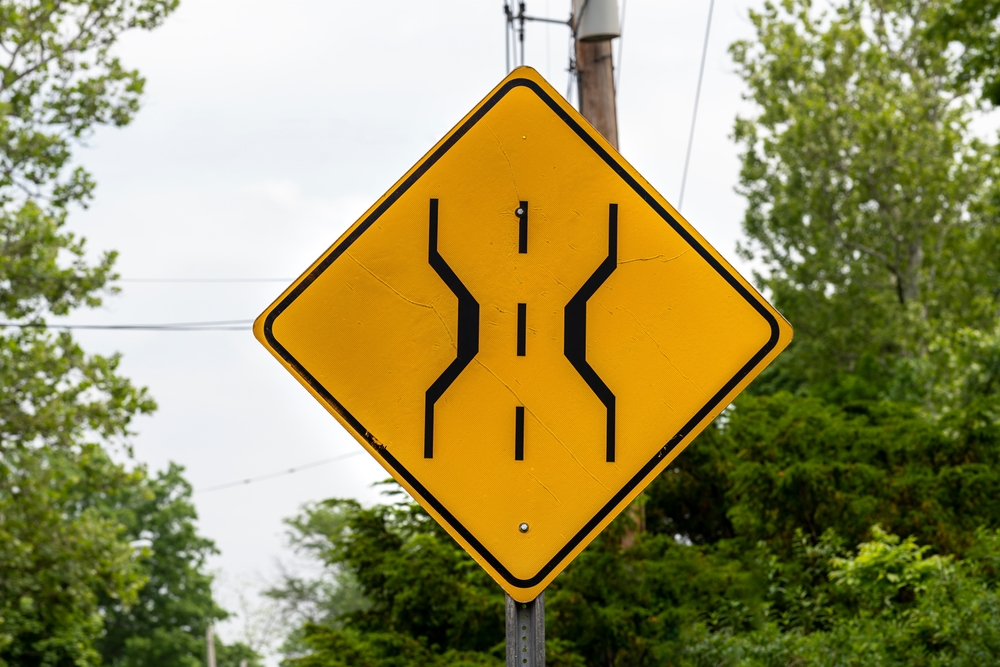
A “NARROW BRIDGE” sign looks obvious, yet drivers still misjudge it. Drivers often underestimate their own width, including mirrors. Perspective on open roads can make the bridge mouth look wider than it is. On rural routes, hedges and stone walls can funnel you toward the span. The danger is not only the bridge. The approach can tempt you to keep speed and position, but then the pinch arrives. The MUTCD gives a measurable trigger for using the sign: “should be used in advance of any bridge or culvert having a roadway clearance less than the width of the approach travel lanes.” That phrasing covers modern bridges and older culverts. It also covers short spans you might not notice. Treat every signed bridge as a pinch point, even when the road surface stays smooth.
Wind can push vehicles sideways suddenly, too. In plain terms, the bridge is tighter than what led you to it. That matters most when two vehicles meet at the same time. It also matters when a wide vehicle meets a cyclist, a pedestrian, or a parked car near the bridge end. When you see the sign, adjust early. Reduce speed before the structure, not on it. Center your vehicle in your lane, because clipped mirrors are common on narrow spans. Watch for oncoming trucks, buses, or farm vehicles that may need extra room. On older bridges, the edges can be unforgiving, with raised kerbs or guardrails. In wet conditions, metal joints and painted markings can reduce grip. If the bridge curves, look through the bend and keep a steady line. Do not brake hard mid span, because that can unsettle the car.
If you tow a trailer, remember the trailer tracks inside the car’s path on curves. Give yourself a clean line and avoid last-second steering. If there is doubt, yield and let the larger vehicle clear first. Many narrow bridges have no shoulder and no escape space. If you meet an oncoming vehicle, stopping early is safer than squeezing in late. At night, use the reflectors and the bridge parapets to judge width. If you drive a large vehicle, slow enough to correct small steering inputs. A slow approach reduces panic, and it protects anyone walking near the rail. If the bridge only fits one moving stream at a time, communicate early.
Slow, then stop before the entrance, so the other driver can read your intent. At night, avoid full beam if it blinds an oncoming driver on the span. Keep a safe following distance, because braking space is limited on the bridge. Many narrow bridges also create a sound and vibration effect that makes drivers tense. The change in surface, echo, and railing height can make the space feel tighter than it is. Stay relaxed and hold a steady line. If the bridge is single-lane, look for priority signs or give way markings before the entrance. Do not enter if an oncoming vehicle has already committed. In the rain, treat the approach like a braking zone, because the bridge deck can be slicker.
Read More: 4 of the Most Overrated Books You Don’t Need to Read
Object Marker
Object markers confuse people because they do not look like instructions. They look like decorations, especially in bright yellow and black. Yet they are serious. They mark fixed hazards, like a median nose, a bridge pier, a closed lane end, or a gore point. The MUTCD makes the direction rule explicit: “shall be sloped down at an angle of 45 degrees toward the side on which traffic is to pass.” In other words, the stripes lean toward the safe side. If the stripes slope down to the right, pass on the right. If they slope down to the left, pass on the left. The message is simple, but drivers miss it when they are tired or distracted. Some object markers show chevrons when traffic can pass on either side. Others sit on temporary barriers during roadworks, which can shift the usual path.
The bright stripes are retroreflective, so they should pop in headlights. Even so, spray and fog can hide them until you are close. Drivers get into trouble when they glance, assume, and then follow a vehicle that is already wrong. This can happen at night, in the rain, or when glare flattens contrast. It can also happen on unfamiliar roads where the obstruction sits at an odd angle. Treat an object marker like a physical wall, not a suggestion. Reduce speed, then pick the side the stripes indicate. Do not cut close, because the marker is often placed just before the hazard. If you ride a motorcycle, remember that debris collects near these points. Gravel and metal fragments can gather at the nose of a divider.
If you drive a tall vehicle, watch for reflectors higher up that show the true edge. Some markers sit before a bridge pier, where the roadway narrows fast. Others sit at the end of a merge lane, where people change lanes late. In both cases, the marker is your final warning. Leave space, signal early, and commit to the correct side. The goal is to guide your eyes, then guide your wheels. Do not overtake near an object marker, because the road is already constrained. Leave extra space in the rain, because standing water can pool near the obstruction.
If you see several markers in a row, expect a channelised path through a work zone. Follow the markers, keep a steady speed, and avoid sudden lane changes. Watch for workers and cones nearby. Expect the road edge to be closer than it looks. Object markers become even more important at night, because they often sit at the exact point where a lane ends or a divider begins. If the marker is on a flexible post, it can wobble in the wind and look less “solid,” yet the hazard behind it is still fixed. In heavy rain, the reflective stripes may appear to smear in headlights, so slow down and rely on lane lines as well. Also note that work zones sometimes use temporary object markers on plastic barriers. Those can shift the safe path from day to day, so do not drive on memory alone.
A.I. Disclaimer: This article was created with AI assistance and edited by a human for accuracy and clarity.
Read More: 7 Phrases Americans Should Avoid Saying When Traveling Abroad, According to a Travel Expert
Trending Products

Red Light Therapy for Body, 660nm 8...

M PAIN MANAGEMENT TECHNOLOGIES Red ...

Red Light Therapy for Body, Infrare...

Red Light Therapy Infrared Light Th...

Handheld Red Light Therapy with Sta...

Red Light Therapy Lamp 10-in-1 with...

Red Light Therapy for Face and Body...

Red Light Therapy Belt for Body, In...

Red Light Therapy for Shoulder Pain...
