
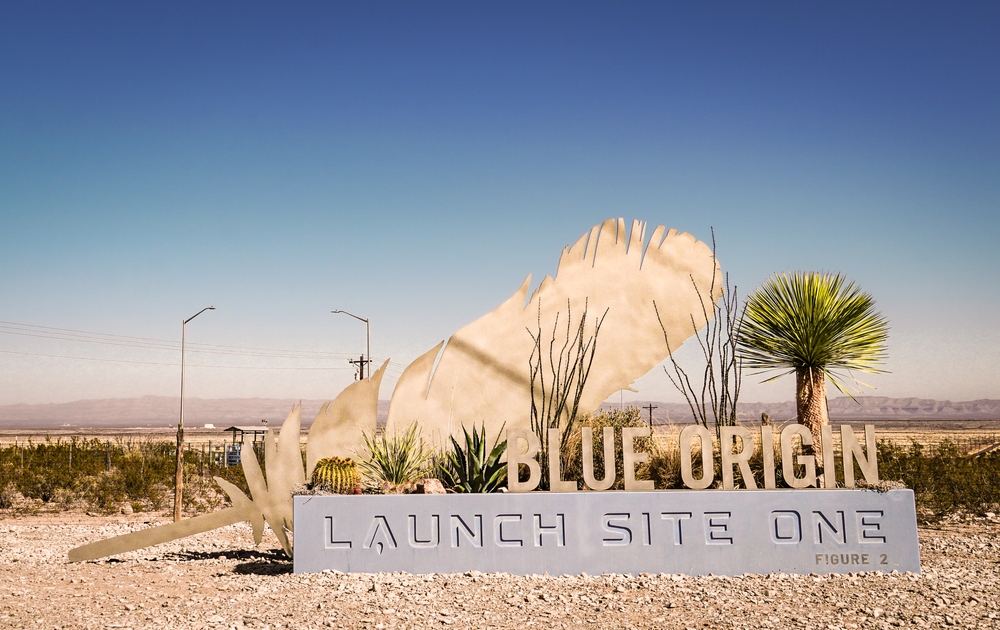
On December 20, 2025, Blue Origin made history by sending the first wheelchair bound person into space. Blue Origin completed the NS-37 mission successfully, launching a team of 6 crew members aboard their rocket, New Shepard. The crew included members: Joey Hyde, Michaela (Michi) Benthaus, Adonis Pourouslis, Jason Stansell, Neal Milc,h and Hans Koenigsmann. The company launched the New Shepard rocket from Launch Site One in West Texas. Aboard the vessel was Michaela “Michi” Benthaus, who became the first wheelchair user to cross the Kármán line, an internationally recognized boundary of space that sits 62 miles above Earth.
Blue Origin’s NS-37 mission marked their 9th flight of 2025 with plans to increase the New Shepard’s flight rate this year. “This crew exemplifies the breadth and diversity of people who can now experience spaceflight, from engineers and scientists to entrepreneurs, teachers, and investors from all over the world,” said Phil Joyce, Senior Vice President of New Shepard. He emphasised their dedication to accessibility, which is adhered to in the design of the New Shepard. The New Shepard was designed with accessibility in mind, offering the opportunity for astronauts with physical impairments such as limited mobility, low vision, hard of hearing,g and wheelchair bound individuals to participate in space exploration.
Mission Scrubbed Before Successful Launch
Blue Origin initially planned to launch on December 18; however, the launch was scrubbed due to issues with built-in checks prior to the flight. The company rescheduled the launch for December 20 with the launch window opening at 8:15 a.m. CST. The NS-37 flight marked Blue Origin’s 37th human spaceflight mission. The New Shepard has flown 92 people (82 individuals) above the Kármán line since beginning passenger flights.
Credit: Shutterstock
Blue Origin was founded by Jeff Bezos in September 2000. The company worked in near secrecy for a decade before going public in 2010. Bezos invested $10 million of his own money into the company. He expressed interest in reducing the cost of space travel while increasing safety.
Benthaus Sustained Injury in 2018 Accident
Michaela (Michi) Benthaus is a 33-year-old aerospace and mechatronics engineer for the European Space Agency. She sustained her life-changing injury from a mountain biking accident in 2018. The accident damaged her spinal cord and left her unable to use her legs. She reached out to a retired aerospace engineer online after her accident. She queried the engineer, asking whether there was any possibility for her to achieve her dream of becoming an astronaut. The responses she received changed her life and encouraged her to pursue spaceflight. Alongside Blue Origin, the engineer assisted in organising the historical 10-minute flight for Benthaus.
Engineer Prepared Through Multiple Programs
Benthaus flew aboard a Zero-G research flight in 2022. The specially modified aircraft creates weightlessness by flying parabolic arcs. Pilots increase the aircraft angle to about 45 degrees relative to the horizon. The plane reaches an altitude of 32,000 feet before pushing over the top of the arc.
Passengers experience approximately 30 seconds of weightlessness during each parabola. The aircraft flies 15 parabolas over the course of each flight. Passengers feel 1.8 times normal gravity during the climb and descent portions.
Zero Gravity Corporation operates these flights from several locations in the United States. The company has conducted thousands of parabolic flights since its founding. The flights serve both entertainment and research purposes.
She also completed an analog astronaut mission, a program designed to simulate space activities and environments on Earth. Participants live in isolated habitats that mimic conditions on other planets. They test equipment and practice procedures astronauts would perform during actual space missions.
Benthaus Joined AstroAccess Program
Benthaus serves as an ambassador for AstroAccess, a nonprofit organization promoting disability inclusion in space exploration. AstroAccess was founded in 2021 and has conducted 5 microgravity missions. The organization flew its first parabolic flight on October 17, 2021.
The first flight carried 12 disability ambassadors, which included a crew of 2 deaf, 6 blind, and 4 mobility-impaired members. The ambassadors tested design solutions during 15 parabolas. Each weightless period lasted approximately 20 seconds. The ambassadors tested multiple accessibility technologies. Blind crew members tested sound beacons for spatial orientation. They experimented with tactile markers inside the cabin while deaf crew members tested communication methods during weightlessness.
The team tested colored light systems to replace auditory warning signals using lights that provided visual cues for different flight phases. Initial placement on the floor proved difficult to see during weightlessness. Future tests will try different light placements.
Ambassadors with mobility impairments focused on station keeping, practicing remaining in specific locations during weightlessness. They tested point-to-point movement techniques with their custom suits, providing management for leg positioning.
Blue Origin Designed Accessibility Accommodations
Blue Origin designed a bench extending from the capsule hatch for the NS-37 mission. The system allowed Benthaus to transfer independently from her wheelchair into her seat. The vehicle required no alterations for the launch, according to Blue Origin officials during the webcast.
She used a special strap to secure her legs during weightlessness. She designed and tested this system during her Zero-G training flights. The strap prevented her legs from floating uncontrollably during microgravity. Hans Koenigsmann sat nearby during the mission. The former SpaceX manager prepared to assist if necessary.
New Shepard Flew Standard Suborbital Profile
The New Shepard rocket stands 19.2 meters tall and 3.8 meters in diameter. The vehicle weighs 75,000 kilograms at launch. A single BE-3PM engine produces 490 kilonewtons of thrust at liftoff. The engine burns liquid hydrogen and liquid oxygen for 141 seconds. Blue Origin named the rocket after Alan Shepard. The astronaut completed America’s first crewed spaceflight on May 5, 1961. His suborbital mission lasted approximately 15 minutes.
Sticking to their dedication to produce sustainable rockets, their BE-3PM engine produces water vapor as its only byproduct. The liquid hydrogen and oxygen combination creates no carbon emissions. Blue Origin describes this as a highly efficient and clean fuel combination.
Blue Origin designed the system to be fully reusable and has successfully launched 29 times. They have also successfully landed as many times, with 1 partial failure and 1 complete failure recorded during their missions. The company has successfully launched and landed New Shepard 29 times, only recording 1 partial failure and 1 complete failure during their missions. The reusability reduces costs and waste.
Joey Hyde Pursued Physics Career
Joey Hyde is a physicist and quantitative investor. He retired from his career at Citadel, a leading hedge fund. He earned a Ph.D. in astrophysics from the University of Pennsylvania and currently resides in Florida with his wife and 5 children. His passion for space exploration began in 1988 when he visited Kennedy Space Center to watch the Space Shuttle Atlantis launch. The experience inspired him to pursue advanced degrees in physics and astronomy, obtaining his Ph.D. in astrophysics.
Hans Koenigsmann Spent Decades at SpaceX
Hans Koenigsmann is a German-American aerospace engineer, joining SpaceX in 2002 as the company’s 4th technical employee. He served as Vice President of Build and Flight Reliability and retired from SpaceX in January 2021. Koenigsmann holds a Ph.D. in Aerospace Engineering from the University of Bremen. He spent two decades at SpaceX developing reusable spacecraft and launch vehicles, and helped develop the Falcon 1, Falcon 9, and Dragon spacecraft.
Koenigsmann supervised flight safety and mission assurance at SpaceX, ensuring crew safety on Dragon missions. He participated in critical launch decisions throughout his tenure at SpaceX. He currently serves in advisory roles across multiple aerospace companies, providing his expertise on reusable rocket technology. Even in retirement, Hans Koenigsmann continues to make significant contributions to the aerospace industry.
Neal Milch Leads Research Institution
Neal Milch serves as Chair of the Board of Trustees at Jackson Laboratory. The nonprofit biomedical research institution focuses on genetic research, with Milch being elected to the board in 2013. He then went on to become chair in 2025. The Jackson Laboratory conducts research to enhance human health. The organization explores genetic factors in disease, maintaining research facilities across multiple states.
Adonis Pouroulis Built a Mining Empire
Adonis Pouroulis is an entrepreneur and mining engineer who’s worked in natural resources and energy for over 3 decades. He founded Petra Diamonds and listed the company on AIM in 1997 and served as Chairman until 2020. Pouroulis founded and chairs Pella Resources, a company focused on critical mineral exploration. He also co-founded Energy Revolution Ventures and currently serves as chairman of Rainbow Rare Earths. He holds the position of CEO at Chariot Limited, a company that develops sustainable energy solutions, focusing on hydrogen and renewable energy projects in Africa.
Jason Stansell Honored Brother’s Memory
Jason Stansell holds a computer science degree from Tulane University. He describes himself as a space enthusiast from West Texas. He dedicated his flight to his brother Kevin, who passed away from brain cancer in 2016. Jason honored his memory by dedicating the NS-37 flight to him.
Suborbital Flights Differ From Orbital Missions
New Shepard flights follow a ballistic trajectory, climbing steeply after launch and continuing coasting after engine shutdown. At the peak altitude, passengers will experience weightlessness, and the vessel returns to Earth without achieving orbit. Orbital missions require higher speeds to circle Earth, which would require the spacecraft to reach speeds of approximately 17,500 miles per hour to maintain orbit.
New Shepard passengers train for 3 to 4 days before flying. The minimal training makes suborbital flights accessible to more people. Blue Origin plans to increase flight frequency as the company continues developing its technology. Each mission provides data about passenger experiences and accessibility needs.
European Space Agency Launched Parastronaut Program
The European Space Agency opened astronaut applications on March 31, 2021, with application acceptance closing on June 18, 2021. The agency received applications from 22 member states and 3 associate members. ESA launched the Parastronaut Feasibility Project alongside standard recruitment. The initiative sought qualified candidates with physical disabilities. Director David Parker described it as an innovation whose time had come.
The agency selected 5 career astronauts and 12 reserve astronauts who had to go through a 6-step interview process. John McFall joined the parastronaut project as a candidate. The orthopaedic surgeon became the first person with a physical disability selected for astronaut training.
The program demonstrates institutional commitment to inclusive spaceflight. It signals that major space agencies recognize the value of diversity. The initiative paves the way for future disabled astronauts.
Read More: Adrift in Space: New Rogue Planets Found Without Host Stars
Benthaus Recalls Her Experience
Benthaus excitedly stated, “It was the coolest experience!” after landing in a video shared by Blue Origin. She explained that while she enjoyed the weightlessness and the view, she also appreciated the journey overall. Benthaus explained that after her accident, she “really, really figured out how inaccessible our world still is” for those with disabilities.
The retired SpaceX manager, Hans Koenigsmann, who aided in organising the trip, stated that Benthaus was the inspiration behind pushing this project. He stated her ambition and drive towards the possibility of space travel with disabilities. “It’s her drive that kind of convinced me I should do that, too, and to just experience something that I’ve seen from the outside for a long time,” he said.
The cost of the NS-37 mission remains unknown and is the 16th suborbital space tourism launch done by Blue Origin. Last April, the company took pop star Katy Perry, CBS presenter Gayle King, and Bezos’s fiancée Lauren Sachez as part of a group of 6 women into the “boundary” of space aboard a Blue Origin vessel. The flight lasted 11-minutes. It seems like the race to capitalise on commercial space travel is accelerating, with many competitors vying to get travellers into space.
Read More: What’s the Scariest Possible Signal We Could Receive From Outer Space?
Trending Products

Red Light Therapy for Body, 660nm 8...

M PAIN MANAGEMENT TECHNOLOGIES Red ...

Red Light Therapy for Body, Infrare...

Red Light Therapy Infrared Light Th...

Handheld Red Light Therapy with Sta...

Red Light Therapy Lamp 10-in-1 with...

Red Light Therapy for Face and Body...

Red Light Therapy Belt for Body, In...

Red Light Therapy for Shoulder Pain...
